
Wind Angle Explained: How Wind Direction Affects Your Boat
There are four key components to how wind can affect your outing on the water: sustained wind speed, wind gusts, wind direction, and wind angle. Here we focus on wind angle.
Wind angle is the angle between the bow (front) of a boat and the direction the wind is coming from. Wind angle tells you where the wind will be hitting your boat. On every boat, wind angle deserves close attention throughout the duration of your outing, because it often changes as your heading and the wind direction shift.
Powerboaters
Wind angle plays a major role in how a powerboat behaves. It affects comfort, safety, windage, engine effort, and fuel efficiency. Powerboaters must adjust their throttle, engine trim, and steering based on their heading relative to the wind.
- Head Winds are winds moving directly onto the front of the boat, requiring higher RPMs to maintain cruising speed.
- Beam Winds hit the boat on the side, requiring constant steering correction to keep the boat on course, plus adjustments to minimize spray for crew comfort.
- Following Winds come from behind, requiring less throttle effort.
- Quartering Winds come at an angle and require active steering.
Sailboaters
Wind angle is known as the point of sail amongst sailboaters. It is distinguished by the degree at which the wind is hitting the sailboat, illustrated below.
- "No-Go Zone" (0°–45°): Pointing directly into the wind causes the sails to flap (luff), causing the boat to lose speed and steerage.
- Close-Hauled & Close Reach (30°–70°): Sailing as close to the wind as possible with tight sails. The sails act like airplane wings, creating lift to pull the boat forward and progress upwind in a zigzag pattern called "tacking."
- Beam Reach (90°): The wind hits the side of the boat, making this the easiest, most comfortable, and usually the fastest point of sail.
- Broad Reach & Running (135°–180°): Sailing with the wind coming from behind. The sails are pushed by the wind rather than generating lift. While intuitive, sailing directly downwind (running) is actually slower than reaching and requires careful steering to avoid accidental gybes.
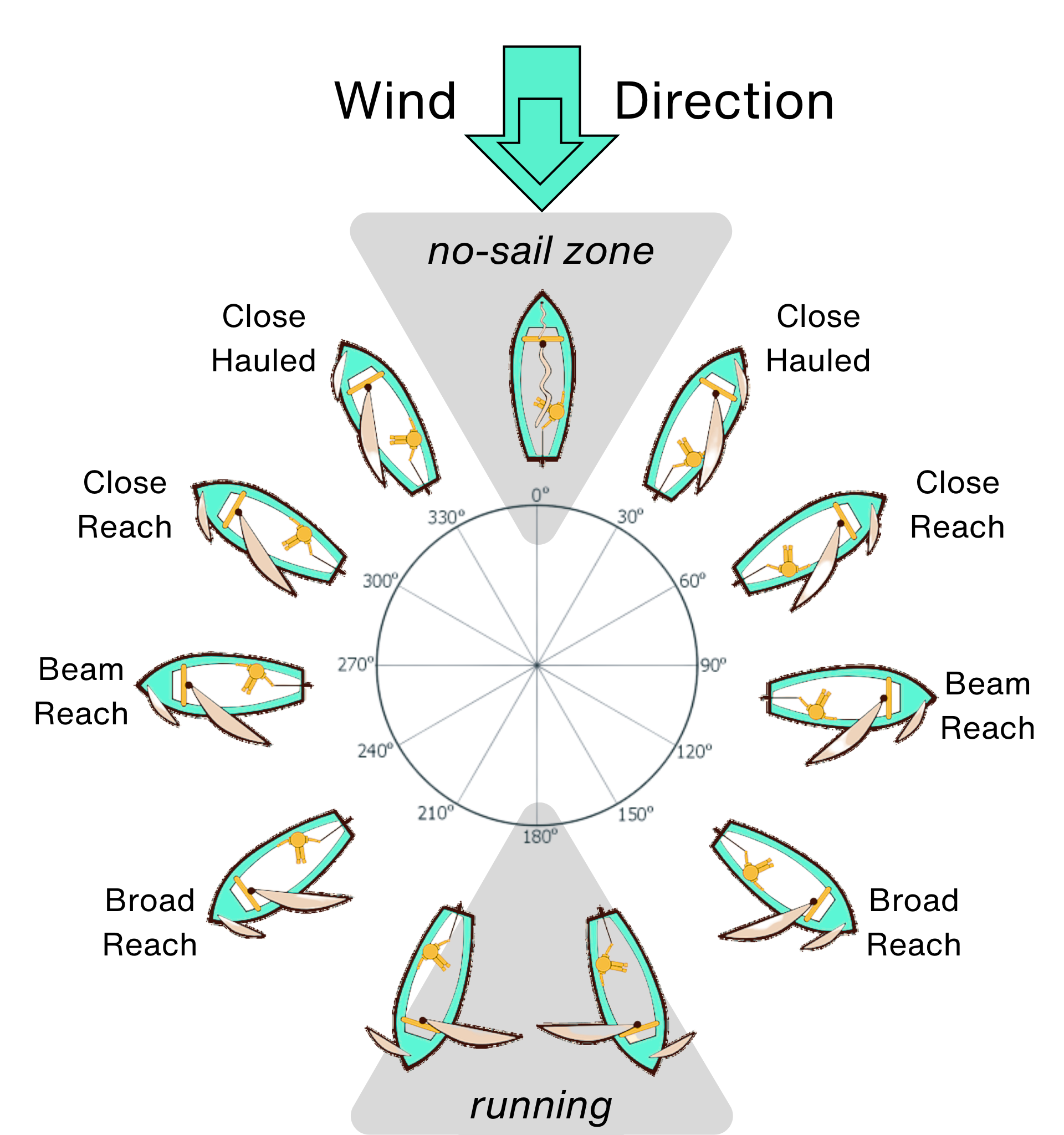
Points of sail relative to wind direction.